Volume 23, Issue 1 (3-2026)
J Res Dev Nurs Midw 2026, 23(1): 38-44 |
Back to browse issues page


Download citation:
BibTeX | RIS | EndNote | Medlars | ProCite | Reference Manager | RefWorks
Send citation to:


BibTeX | RIS | EndNote | Medlars | ProCite | Reference Manager | RefWorks
Send citation to:
Ebrahimi Khozani N, Truog R, Shoghi M. Pediatric intensive care nurses' perspectives on the quality of dying and death among hospitalized children: A Cross-Sectional Study. J Res Dev Nurs Midw 2026; 23 (1) :38-44
URL: http://nmj.goums.ac.ir/article-1-2339-en.html
URL: http://nmj.goums.ac.ir/article-1-2339-en.html


1- Department of Pediatric and Neonatal Intensive Care Nursing, Iran University of Medical Sciences, Tehran, Iran
2- Medical School, Boston, Massachusetts, United States of America; Pediatric Intensive Care Unit, Boston Children’s Hospital, Boston, Massachusetts, United States of America
3- Nursing and Midwifery Care Research Center, Health Management Research Institute, Iran University of Medical Sciences, Tehran, Iran ,shoghimmahnaz@yahoo.com
2- Medical School, Boston, Massachusetts, United States of America; Pediatric Intensive Care Unit, Boston Children’s Hospital, Boston, Massachusetts, United States of America
3- Nursing and Midwifery Care Research Center, Health Management Research Institute, Iran University of Medical Sciences, Tehran, Iran ,
Full-Text [PDF 511 kb]
(477 Downloads)
| Abstract (HTML) (1766 Views)
Discussion
In this cross-sectional study of PICU nurses, the perceived quality of dying and death (QODD) of hospitalized children was moderate to favorable, with higher scores in continuity of care, fulfillment of the parental role, emotional support for the family, and symptom management. The mean QODD score indicates that, from nurses' perspectives, end-of-life care in these settings is generally acceptable, although room for improvement remains. This pattern is consistent with previous studies reporting relatively high QODD scores and positive evaluations of pediatric end-of-life care (20,21). Similarly, Bailey et al. and Hales et al. reported favorable perceptions in pediatric cardiac intensive care populations (10). In contrast, Ghahramani et al. found lower scores in adult ICU settings, likely reflecting differences in patient characteristics, care environments, and measurement approaches (22). Importantly, discrepancies between professional and family perspectives remain evident, as families often report unmet informational and emotional needs despite acceptable clinical evaluations (23,24).
Domain-specific findings revealed a heterogeneous pattern. The highest scores were observed for continuity and coordination of care, parental role fulfillment, emotional support, and pain and symptom management. These findings align with prior studies emphasizing the importance of coordinated care and effective communication in improving end-of-life experiences (25,26). High ratings for maintaining the child's dignity and ensuring effective information transfer between shifts suggest that nurses play a central role in fostering trust and reducing uncertainty for families (27). These strengths highlight the contribution of multidisciplinary teamwork and consistent caregiving in pediatric intensive care settings.
Despite these strengths, important gaps were identified. The lowest scores were related to spirituality and religious-cultural aspects, as well as the physical and instrumental needs of families. Similar findings have been reported in previous studies, in which access to spiritual care and religious support was limited (22,28,29). This issue is particularly relevant in Iran, where spiritual and religious beliefs significantly shape how families interpret illness, suffering, and death. Barriers such as limited formal training in spiritual care, lack of confidence in addressing spiritual concerns, insufficient access to chaplaincy services, time constraints, and uncertainty about professional boundaries may contribute to these low scores (14,28-30). Previous research has also shown that although nurses recognize the importance of spiritual care, they often feel inadequately prepared and insufficiently supported to provide it (14,28-30).
In addition, practical aspects of family support, including accommodation, transportation, privacy, and access to basic facilities, received relatively low scores. Although these factors may appear secondary in high-technology PICU environments, they can substantially influence families' experiences during a child's final days. Addressing these needs is essential for delivering holistic, family-centered care. Together, these findings suggest that PICU teams should broaden their focus beyond clinical management and communication to include structured spiritual care and practical support for families (8,28).
Regarding nurse-related factors, univariate analyses indicated that older age, greater PICU experience, fixed work shifts, supervisory roles, permanent employment, and prior training in end-of-life or post-mortem care were associated with higher QODD scores. These findings are consistent with earlier research showing that more experienced nurses tend to have greater confidence in symptom management, communication, and ethical decision-making (23,26,31,32). However, in the multivariable analysis, only work shift remained a significant predictor. Nurses working fixed shifts reported QODD scores approximately seven points higher than those working rotating shifts. One plausible explanation is that fixed shifts facilitate continuity of care and allow nurses to build more stable therapeutic relationships with patients and families, thereby improving communication and overall care quality at the end of life (24,33,34). Nevertheless, this association should be interpreted cautiously, as unmeasured variables such as burnout, staffing patterns, and individual communication skills may have influenced the results.
The association between training and higher QODD scores, although not retained in the final model, warrants further consideration. Nurses who had received training in caring for dying children and post-mortem care reported higher scores in unadjusted analyses. This may reflect confounding by experience, as more experienced nurses are both more likely to have received training and to feel more competent in end-of-life care (14,16,35,36). Previous studies suggest that structured education can improve knowledge, attitudes, and self-confidence, although its impact on perceived care quality is not always consistent (32,37). The effectiveness of training may depend on its content, delivery methods, and the extent to which learned skills can be applied in clinical practice. Therefore, educational interventions should specifically target identified gaps, particularly in spiritual care and practical family support, and should be accompanied by organizational changes that facilitate their implementation (37,38).
These findings have important practical implications. Existing strengths, including effective coordination of care, symptom management, and emotional support, should be maintained through adequate staffing, interdisciplinary collaboration, and supportive institutional policies. At the same time, targeted efforts are needed to improve spiritual care and address families' practical needs. This may include integrating spiritual care providers into PICU teams, enhancing access to religious or cultural support services, improving the physical environment, and acknowledging the logistical challenges faced by families.
Several limitations should be considered. The study was conducted in four teaching hospitals in Tehran, which may limit its generalizability to other settings. The exclusion of nurses with a personal history of child loss, although ethically justified, may have reduced the diversity of perspectives. Recall bias is possible, as nurses were asked to report on recent experiences, although this was mitigated by limiting the recall period to one month. Additionally, the use of a clinician-reported measure without validation against family-reported outcomes or direct observation limits the ability to assess the objective quality of care. Finally, some QODD domains are based on single items, which may affect the reliability of domain-specific interpretations.
Finally, the regression model had limited explanatory power, the fixed-shift group was much smaller than the rotating-shift group, and multiple univariate tests were conducted; therefore, the regression findings should be interpreted cautiously and confirmed in larger multicenter studies.
Conclusion
Nurses working in pediatric intensive care units generally viewed the quality of dying and death among hospitalized children as acceptable. Areas such as continuity of care, symptom control, and emotional support for families were perceived positively; however, gaps remained in meeting families' spiritual and practical needs. These findings emphasize the importance of strengthening holistic and family-centered end-of-life care to ensure a more compassionate experience for children and their families in PICUs. Future research should include parents' perspectives, directly compare family and staff evaluations of end-of-life care, and test targeted educational and organizational interventions, particularly in the areas of spiritual support and practical assistance, to optimize pediatric palliative and end-of-life care in different settings.
Acknowledgement
We would like to thank all parents and the Ethics Committee of Iran University of Medical Sciences for their support.
Funding Sources
This study was funded by Iran University of Medical Sciences.
Ethical Statement
The study protocol was approved by the Ethics Committee of Iran University of Medical Sciences (Approval code: IR.IUMS.REC.1402.976). Written informed consent was obtained from all participants. Participants were informed of their right to withdraw from the study at any stage, and the confidentiality of their personal information was strictly maintained.
Conflicts of Interest
The authors declare that they have no competing interests.
Author Contributions
Author N.E. contributed to the conception and design of the study, data collection, data analysis and interpretation, and drafting of the manuscript. Author R.T. contributed to data management, manuscript revision, and scale interpretation and scoring. Author M. Sh. contributed to the study design, supervision of the research process, critical revision of the manuscript for important intellectual content, and interpretation of the findings. All authors made substantial contributions to the work, reviewed and approved the final manuscript, and agreed to be accountable for all aspects of the study in accordance with ICMJE authorship criteria.
Data Availability Statement
Data will be made available upon reasonable request, subject to review by the research team and consideration of data confidentiality.
Use of Artificial Intelligence
AI-assisted tools were used to support language editing; these tools were not involved in data analysis, the writing of scientific content, the interpretation of results, or scientific decision-making.
Full-Text: (150 Views)
Introduction
Pediatric intensive care units (PICUs) care for children with life-threatening conditions, and death remains an important outcome despite advances in critical care. International reports show that PICU mortality varies widely by setting, case mix, resources, and organization of care; some high-resource pediatric critical care studies report rates of around or below 3% (1), whereas a prospective study from an Iranian PICU reported a mortality rate of 12.2% (2). These deaths often occur after complex clinical and ethical decision-making, including decisions about withholding or withdrawing life-sustaining treatments (3). Quality of dying and death (QODD) refers to the extent to which a person's physical, psychological, social, cultural, and spiritual needs are met during the dying process, as well as the extent to which dignity, comfort, communication, and family preferences are respected at the end of life (4,5). For nurses, QODD is a particularly important concept because it integrates bedside symptom management, communication, family support, and ethical care into a practical indicator of end-of-life care quality (6,7).
The death of a child in the pediatric intensive care unit (PICU) is one of the most difficult situations that nurses encounter in their professional lives. It requires not only highly specialized clinical care but also continuous emotional and practical support for the child and family during a period of intense stress and uncertainty (6,8,9). In this context, the quality of dying and death has become an important framework for understanding end-of-life care. It includes the extent to which symptoms are controlled, whether the child is comfortable, how clearly and honestly the healthcare team communicates, and how well the family's values, beliefs, and needs are respected. Considering these aspects helps move beyond a narrow focus on survival and shifts attention toward what it means to provide high-quality care when a child is approaching the end of life (10).
PICU nurses are central to this process. They are present at the bedside throughout the day and night, closely monitoring the child's condition, administering treatments, and providing comfort through small but meaningful actions, such as repositioning, speaking softly, or simply being present. They also spend considerable time with parents and other family members, listening to their concerns, explaining procedures, and answering difficult questions (11). Because of this close involvement, nurses develop a detailed understanding of the child's suffering or comfort, as well as the family's emotional state and experience of the dying process (12). Therefore, nurses' perspectives are crucial for evaluating the quality of dying and death among hospitalized children.
Caring for dying children, however, is also emotionally and ethically challenging for nurses (13). They may experience moral distress when aggressive treatments are continued despite a poor prognosis or when they believe that a child's suffering could be reduced but decisions are delayed (14). Repeated exposure to such situations can contribute to sadness, helplessness, compassion fatigue, and burnout (15). Understanding how nurses perceive the quality of dying and death is important not only for improving care for children and families but also for supporting the well-being and resilience of the nursing staff who care for them (16).
Although international studies have examined end-of-life care and QODD in pediatric and adult intensive care settings, evidence from Iran remains limited, particularly from the perspective of PICU nurses. Cultural and religious values, family expectations, resource constraints, and the organization of pediatric palliative care may shape how dying and death are experienced in Iranian PICUs. Therefore, examining the quality of dying and death of hospitalized children from the perspective of nurses working in PICUs is highly relevant to pediatric nursing and to the development of pediatric palliative and end-of-life care in Iran. Exploring nurses' evaluations of symptom management, communication, decision-making, spiritual care, continuity, and family support can reveal important strengths and gaps in current practice. This knowledge can guide evidence-based guidelines, educational programs, and supportive institutional policies that promote more compassionate, family-centered, and ethically grounded care at the end of a child's life. Therefore, this study aimed to determine the quality of dying and death of hospitalized children from the perspective of nurses working in PICUs and to identify nurse-related factors associated with these perceptions.
Methods
This cross-sectional study was reported in accordance with the Strengthening the Reporting of Observational Studies in Epidemiology (STROBE) guideline (17). The study was conducted among nurses working in pediatric intensive care units (PICUs) in four teaching hospitals in Tehran, Iran, including seven PICU wards. Census sampling was used. Therefore, all 185 nurses who met the inclusion criteria during the study period were invited to participate; 176 nurses agreed and completed the study, yielding a response rate of 95.1%. Eligible nurses had at least a bachelor's degree in nursing, a minimum of 12 months of work experience in a PICU, direct experience caring for terminally ill children during their career, and no personal history of losing a child.
Data were collected from December 2024 to March 2025 using a structured, self-report questionnaire. The first author visited each of the four participating hospitals during morning, evening, and night shifts to reach nurses across different work patterns. At each visit, eligible nurses received an explanation of the study aims, eligibility criteria, voluntary participation, confidentiality, and the right to withdraw. Written informed consent was obtained from all participants before questionnaire distribution.
After providing consent, questionnaires were distributed to the nurses. To improve consistency and reduce recall bias, participants were asked to think about the most recent child who had died in the PICU within the previous month and to answer the questions based on their own experience of that child's end-of-life care. Nurses completed the questionnaire during breaks or at the end of their shifts and could ask the researcher for clarification if any item was unclear.
Completed questionnaires were returned in sealed envelopes and stored securely to protect anonymity. Returned questionnaires were reviewed for completeness before data entry. In the submitted SPSS dataset, no missing values were found for demographic, professional, PICU-QODD item, domain, or total-score variables; therefore, all 176 cases were included in the descriptive and regression analyses.
Data collection was completed over three months, and the average time required to complete the questionnaire was approximately 20 minutes.
The questionnaire consisted of two parts. The first part collected demographic and professional information, including age, gender, marital status, education level, years of experience in intensive care units, work shift pattern, organizational position, type of employment, nurse-to-patient ratio, and previous participation in training courses related to dying and death.
The second part assessed QODD using the Pediatric Intensive Care Unit Quality of Dying and Death (PICU-QODD) questionnaire. This clinician-reported measure is designed to assess healthcare providers' perceptions of the child's dying process, death, and the period immediately after death; it is not a direct observational measure and does not replace parent- or family-reported outcomes. The instrument comprises 20 items grouped into 10 domains: pain and symptom management (3 items), communication issues (4 items), decisions to withdraw life support (2 items), privacy and PICU environment (1 item), physical and instrumental needs of the family (1 item), emotional support for the family (3 items), fulfillment of the parental role (1 item), spirituality and religious/cultural issues (2 items), continuity and coordination of care (1 item), and grief and bereavement (2 items). Each item is rated on an 11-point Likert scale from 0 ("terrible") to 10 ("ideal"). Total scores were standardized to a 0-100 scale by multiplying the mean item score by 10; higher scores indicate better perceived quality of dying and death (6).
According to Ghoshal, different versions of the QODD, including the PICU-QODD-20 version, have been used and adapted in several countries and intensive care settings (18). A Persian version of the QODD has demonstrated acceptable validity and high internal consistency in previous research among nurses working in neonatal intensive care units in Iran (Cronbach's alpha = 0.896) (19). For the present PICU context, the questionnaire was translated and culturally reviewed using a forward-translation process. Two translators fluent in English independently translated the instrument into Persian. The translated questionnaire and the original English version were then reviewed by five faculty members of the School of Nursing and Midwifery to assess face and content validity. Their comments were incorporated in consultation with the research team, and the final Persian version was prepared for use in the study.
Reliability was assessed using the test-retest method. The questionnaire was administered to 10 nurses working in pediatric intensive care units, and the retest was conducted after a 20-day interval. The correlation coefficients between the two administrations for the subscales were as follows: pain and symptom management (0.745), communication issues (0.775), decisions regarding withdrawal of planned life-sustaining treatments (0.767), privacy and PICU environment issues (0.702), family physical and instrumental needs (0.730), family emotional/support needs (0.770), parental role (0.763), spirituality and cultural/religious issues (0.711), continuity and coordination of care (0.751), and grief and bereavement (0.783). The total score correlation coefficient was 0.714. These nurses were not included in the main study. The internal consistency of the questionnaire in the main sample was acceptable (Cronbach's alpha = 0.896).
Data were analyzed using SPSS version 24. Descriptive statistics, including frequencies, percentages, means, and standard deviations, were used to summarize participants’ characteristics and QODD scores. Normality was assessed using skewness and kurtosis values, along with inspection of residual plots. Group comparisons were performed using independent t-tests for two groups and one-way ANOVA for three or more groups. Pearson’s correlation coefficient was used to examine relationships between continuous variables with normal distributions. To identify independent predictors of the overall QODD score, a multiple linear regression model (enter method) was conducted, including variables with theoretical relevance or those showing statistically significant associations in univariate analysis. Model assumptions, including normality, homoscedasticity, multicollinearity, and independence, were assessed. Regression coefficients (β) and their 95% confidence intervals were reported. Statistical significance was set at p < 0.05.
Results
A total of 176 nurses participated in the study. Most nurses were female (81.8%), and the mean age was 33.06 years, with a mean PICU experience of 6.48 years. Ninety-four nurses (53.4%) were married. Most nurses held a bachelor's degree (148, 84.1%), and 28 (15.9%) had a master's degree. The majority worked rotating shifts (147: 83.5%), whereas 29 (16.5%) worked fixed shifts. Most participants were clinical nurses (160: 90.9%), and 16 (9.1%) were unit supervisors. Regarding employment type, 72 nurses (40.9%) were permanently employed, 45 (25.6%) had contractual positions, 32 (18.2%) were project-based, and 27 (15.4%) had corporate or temporary contracts. The average nurse-to-patient ratio per shift was 2.0 patients per nurse (SD=0.69). Only 58 nurses (33%) had completed training on pediatric end-of-life and post-mortem care, whereas 118 (67%) had not (Table 1).
The mean standardized overall QODD score was 68.44 ± 15.60. Because no validated cutoff score has been established for classifying PICU-QODD levels in this context, this value was interpreted descriptively as reflecting relatively favorable perceptions. The highest domain mean was observed for continuity/coordination of care (84.40 ± 18.10), and the lowest domains were spirituality/religious-cultural issues (33.46 ±24.10) and physical/instrumental needs of the family (49.10 ± 29.20). Skewness and kurtosis were -0.291 and -0.597, respectively, indicating a normal distribution of the residuals. Domain-specific scores are presented in Table 2.
Table 3 shows the relationships between QODD scores and nurses' demographic and professional characteristics. QODD scores had weak positive linear correlations with age (r = 0.170, p = 0.024) and PICU experience (r = 0.223, p = 0.003), indicating that older and more experienced nurses tended to report slightly higher QODD scores. There were no significant differences in QODD scores by gender or marital status. Because the observed correlation coefficients were small, these findings should be interpreted as weak associations.
In the multivariable model including PICU experience, job position, employment type, training, and work shift, only work shift remained significantly associated with QODD scores (B = 7.01, 95% CI (0.343,13.688)). All variance inflation factor (VIF) values were well below the conventional threshold of 5 (Range: 1.137-3.786), indicating the absence of significant multicollinearity among the predictor variables in the regression model. To ensure the robustness of the results in the presence of group imbalance, a bootstrapping method (With 1,000 resamples) was applied to confirm the robustness of the regression findings. The bootstrapping results confirmed that shift type remained significantly associated with the outcome (B = 7.015, 95% CI 1.621-12.587). Nurses working fixed shifts had QODD scores 7.01 points higher than those working rotating shifts (Table 4).
Pediatric intensive care units (PICUs) care for children with life-threatening conditions, and death remains an important outcome despite advances in critical care. International reports show that PICU mortality varies widely by setting, case mix, resources, and organization of care; some high-resource pediatric critical care studies report rates of around or below 3% (1), whereas a prospective study from an Iranian PICU reported a mortality rate of 12.2% (2). These deaths often occur after complex clinical and ethical decision-making, including decisions about withholding or withdrawing life-sustaining treatments (3). Quality of dying and death (QODD) refers to the extent to which a person's physical, psychological, social, cultural, and spiritual needs are met during the dying process, as well as the extent to which dignity, comfort, communication, and family preferences are respected at the end of life (4,5). For nurses, QODD is a particularly important concept because it integrates bedside symptom management, communication, family support, and ethical care into a practical indicator of end-of-life care quality (6,7).
The death of a child in the pediatric intensive care unit (PICU) is one of the most difficult situations that nurses encounter in their professional lives. It requires not only highly specialized clinical care but also continuous emotional and practical support for the child and family during a period of intense stress and uncertainty (6,8,9). In this context, the quality of dying and death has become an important framework for understanding end-of-life care. It includes the extent to which symptoms are controlled, whether the child is comfortable, how clearly and honestly the healthcare team communicates, and how well the family's values, beliefs, and needs are respected. Considering these aspects helps move beyond a narrow focus on survival and shifts attention toward what it means to provide high-quality care when a child is approaching the end of life (10).
PICU nurses are central to this process. They are present at the bedside throughout the day and night, closely monitoring the child's condition, administering treatments, and providing comfort through small but meaningful actions, such as repositioning, speaking softly, or simply being present. They also spend considerable time with parents and other family members, listening to their concerns, explaining procedures, and answering difficult questions (11). Because of this close involvement, nurses develop a detailed understanding of the child's suffering or comfort, as well as the family's emotional state and experience of the dying process (12). Therefore, nurses' perspectives are crucial for evaluating the quality of dying and death among hospitalized children.
Caring for dying children, however, is also emotionally and ethically challenging for nurses (13). They may experience moral distress when aggressive treatments are continued despite a poor prognosis or when they believe that a child's suffering could be reduced but decisions are delayed (14). Repeated exposure to such situations can contribute to sadness, helplessness, compassion fatigue, and burnout (15). Understanding how nurses perceive the quality of dying and death is important not only for improving care for children and families but also for supporting the well-being and resilience of the nursing staff who care for them (16).
Although international studies have examined end-of-life care and QODD in pediatric and adult intensive care settings, evidence from Iran remains limited, particularly from the perspective of PICU nurses. Cultural and religious values, family expectations, resource constraints, and the organization of pediatric palliative care may shape how dying and death are experienced in Iranian PICUs. Therefore, examining the quality of dying and death of hospitalized children from the perspective of nurses working in PICUs is highly relevant to pediatric nursing and to the development of pediatric palliative and end-of-life care in Iran. Exploring nurses' evaluations of symptom management, communication, decision-making, spiritual care, continuity, and family support can reveal important strengths and gaps in current practice. This knowledge can guide evidence-based guidelines, educational programs, and supportive institutional policies that promote more compassionate, family-centered, and ethically grounded care at the end of a child's life. Therefore, this study aimed to determine the quality of dying and death of hospitalized children from the perspective of nurses working in PICUs and to identify nurse-related factors associated with these perceptions.
Methods
This cross-sectional study was reported in accordance with the Strengthening the Reporting of Observational Studies in Epidemiology (STROBE) guideline (17). The study was conducted among nurses working in pediatric intensive care units (PICUs) in four teaching hospitals in Tehran, Iran, including seven PICU wards. Census sampling was used. Therefore, all 185 nurses who met the inclusion criteria during the study period were invited to participate; 176 nurses agreed and completed the study, yielding a response rate of 95.1%. Eligible nurses had at least a bachelor's degree in nursing, a minimum of 12 months of work experience in a PICU, direct experience caring for terminally ill children during their career, and no personal history of losing a child.
Data were collected from December 2024 to March 2025 using a structured, self-report questionnaire. The first author visited each of the four participating hospitals during morning, evening, and night shifts to reach nurses across different work patterns. At each visit, eligible nurses received an explanation of the study aims, eligibility criteria, voluntary participation, confidentiality, and the right to withdraw. Written informed consent was obtained from all participants before questionnaire distribution.
After providing consent, questionnaires were distributed to the nurses. To improve consistency and reduce recall bias, participants were asked to think about the most recent child who had died in the PICU within the previous month and to answer the questions based on their own experience of that child's end-of-life care. Nurses completed the questionnaire during breaks or at the end of their shifts and could ask the researcher for clarification if any item was unclear.
Completed questionnaires were returned in sealed envelopes and stored securely to protect anonymity. Returned questionnaires were reviewed for completeness before data entry. In the submitted SPSS dataset, no missing values were found for demographic, professional, PICU-QODD item, domain, or total-score variables; therefore, all 176 cases were included in the descriptive and regression analyses.
Data collection was completed over three months, and the average time required to complete the questionnaire was approximately 20 minutes.
The questionnaire consisted of two parts. The first part collected demographic and professional information, including age, gender, marital status, education level, years of experience in intensive care units, work shift pattern, organizational position, type of employment, nurse-to-patient ratio, and previous participation in training courses related to dying and death.
The second part assessed QODD using the Pediatric Intensive Care Unit Quality of Dying and Death (PICU-QODD) questionnaire. This clinician-reported measure is designed to assess healthcare providers' perceptions of the child's dying process, death, and the period immediately after death; it is not a direct observational measure and does not replace parent- or family-reported outcomes. The instrument comprises 20 items grouped into 10 domains: pain and symptom management (3 items), communication issues (4 items), decisions to withdraw life support (2 items), privacy and PICU environment (1 item), physical and instrumental needs of the family (1 item), emotional support for the family (3 items), fulfillment of the parental role (1 item), spirituality and religious/cultural issues (2 items), continuity and coordination of care (1 item), and grief and bereavement (2 items). Each item is rated on an 11-point Likert scale from 0 ("terrible") to 10 ("ideal"). Total scores were standardized to a 0-100 scale by multiplying the mean item score by 10; higher scores indicate better perceived quality of dying and death (6).
According to Ghoshal, different versions of the QODD, including the PICU-QODD-20 version, have been used and adapted in several countries and intensive care settings (18). A Persian version of the QODD has demonstrated acceptable validity and high internal consistency in previous research among nurses working in neonatal intensive care units in Iran (Cronbach's alpha = 0.896) (19). For the present PICU context, the questionnaire was translated and culturally reviewed using a forward-translation process. Two translators fluent in English independently translated the instrument into Persian. The translated questionnaire and the original English version were then reviewed by five faculty members of the School of Nursing and Midwifery to assess face and content validity. Their comments were incorporated in consultation with the research team, and the final Persian version was prepared for use in the study.
Reliability was assessed using the test-retest method. The questionnaire was administered to 10 nurses working in pediatric intensive care units, and the retest was conducted after a 20-day interval. The correlation coefficients between the two administrations for the subscales were as follows: pain and symptom management (0.745), communication issues (0.775), decisions regarding withdrawal of planned life-sustaining treatments (0.767), privacy and PICU environment issues (0.702), family physical and instrumental needs (0.730), family emotional/support needs (0.770), parental role (0.763), spirituality and cultural/religious issues (0.711), continuity and coordination of care (0.751), and grief and bereavement (0.783). The total score correlation coefficient was 0.714. These nurses were not included in the main study. The internal consistency of the questionnaire in the main sample was acceptable (Cronbach's alpha = 0.896).
Data were analyzed using SPSS version 24. Descriptive statistics, including frequencies, percentages, means, and standard deviations, were used to summarize participants’ characteristics and QODD scores. Normality was assessed using skewness and kurtosis values, along with inspection of residual plots. Group comparisons were performed using independent t-tests for two groups and one-way ANOVA for three or more groups. Pearson’s correlation coefficient was used to examine relationships between continuous variables with normal distributions. To identify independent predictors of the overall QODD score, a multiple linear regression model (enter method) was conducted, including variables with theoretical relevance or those showing statistically significant associations in univariate analysis. Model assumptions, including normality, homoscedasticity, multicollinearity, and independence, were assessed. Regression coefficients (β) and their 95% confidence intervals were reported. Statistical significance was set at p < 0.05.
Results
A total of 176 nurses participated in the study. Most nurses were female (81.8%), and the mean age was 33.06 years, with a mean PICU experience of 6.48 years. Ninety-four nurses (53.4%) were married. Most nurses held a bachelor's degree (148, 84.1%), and 28 (15.9%) had a master's degree. The majority worked rotating shifts (147: 83.5%), whereas 29 (16.5%) worked fixed shifts. Most participants were clinical nurses (160: 90.9%), and 16 (9.1%) were unit supervisors. Regarding employment type, 72 nurses (40.9%) were permanently employed, 45 (25.6%) had contractual positions, 32 (18.2%) were project-based, and 27 (15.4%) had corporate or temporary contracts. The average nurse-to-patient ratio per shift was 2.0 patients per nurse (SD=0.69). Only 58 nurses (33%) had completed training on pediatric end-of-life and post-mortem care, whereas 118 (67%) had not (Table 1).
The mean standardized overall QODD score was 68.44 ± 15.60. Because no validated cutoff score has been established for classifying PICU-QODD levels in this context, this value was interpreted descriptively as reflecting relatively favorable perceptions. The highest domain mean was observed for continuity/coordination of care (84.40 ± 18.10), and the lowest domains were spirituality/religious-cultural issues (33.46 ±24.10) and physical/instrumental needs of the family (49.10 ± 29.20). Skewness and kurtosis were -0.291 and -0.597, respectively, indicating a normal distribution of the residuals. Domain-specific scores are presented in Table 2.
Table 3 shows the relationships between QODD scores and nurses' demographic and professional characteristics. QODD scores had weak positive linear correlations with age (r = 0.170, p = 0.024) and PICU experience (r = 0.223, p = 0.003), indicating that older and more experienced nurses tended to report slightly higher QODD scores. There were no significant differences in QODD scores by gender or marital status. Because the observed correlation coefficients were small, these findings should be interpreted as weak associations.
In the multivariable model including PICU experience, job position, employment type, training, and work shift, only work shift remained significantly associated with QODD scores (B = 7.01, 95% CI (0.343,13.688)). All variance inflation factor (VIF) values were well below the conventional threshold of 5 (Range: 1.137-3.786), indicating the absence of significant multicollinearity among the predictor variables in the regression model. To ensure the robustness of the results in the presence of group imbalance, a bootstrapping method (With 1,000 resamples) was applied to confirm the robustness of the regression findings. The bootstrapping results confirmed that shift type remained significantly associated with the outcome (B = 7.015, 95% CI 1.621-12.587). Nurses working fixed shifts had QODD scores 7.01 points higher than those working rotating shifts (Table 4).
.PNG)
.PNG)
|
Table 3. Relationship between quality of dying and death scores and nurses' characteristics (n = 176)
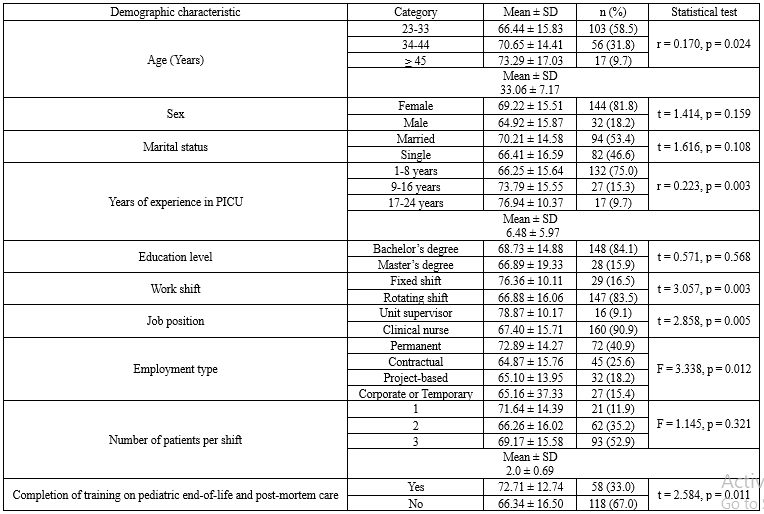 T: Independent samples t-test; F: One-way ANOVA; r: Pearson correlation coefficient Table 4. Multiple linear regression of factors associated with quality of dying and death scores among PICU nurses (n = 176) 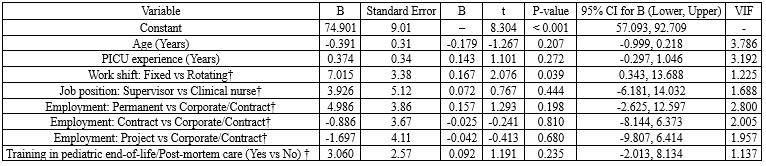 Model statistics: R² = 0.075; Durbin-Watson = 2.01 †Reference categories: Rotating shift; Clinical nurse; Corporate or temporary employment; No training in pediatric end-of-life and post-mortem care |
Discussion
In this cross-sectional study of PICU nurses, the perceived quality of dying and death (QODD) of hospitalized children was moderate to favorable, with higher scores in continuity of care, fulfillment of the parental role, emotional support for the family, and symptom management. The mean QODD score indicates that, from nurses' perspectives, end-of-life care in these settings is generally acceptable, although room for improvement remains. This pattern is consistent with previous studies reporting relatively high QODD scores and positive evaluations of pediatric end-of-life care (20,21). Similarly, Bailey et al. and Hales et al. reported favorable perceptions in pediatric cardiac intensive care populations (10). In contrast, Ghahramani et al. found lower scores in adult ICU settings, likely reflecting differences in patient characteristics, care environments, and measurement approaches (22). Importantly, discrepancies between professional and family perspectives remain evident, as families often report unmet informational and emotional needs despite acceptable clinical evaluations (23,24).
Domain-specific findings revealed a heterogeneous pattern. The highest scores were observed for continuity and coordination of care, parental role fulfillment, emotional support, and pain and symptom management. These findings align with prior studies emphasizing the importance of coordinated care and effective communication in improving end-of-life experiences (25,26). High ratings for maintaining the child's dignity and ensuring effective information transfer between shifts suggest that nurses play a central role in fostering trust and reducing uncertainty for families (27). These strengths highlight the contribution of multidisciplinary teamwork and consistent caregiving in pediatric intensive care settings.
Despite these strengths, important gaps were identified. The lowest scores were related to spirituality and religious-cultural aspects, as well as the physical and instrumental needs of families. Similar findings have been reported in previous studies, in which access to spiritual care and religious support was limited (22,28,29). This issue is particularly relevant in Iran, where spiritual and religious beliefs significantly shape how families interpret illness, suffering, and death. Barriers such as limited formal training in spiritual care, lack of confidence in addressing spiritual concerns, insufficient access to chaplaincy services, time constraints, and uncertainty about professional boundaries may contribute to these low scores (14,28-30). Previous research has also shown that although nurses recognize the importance of spiritual care, they often feel inadequately prepared and insufficiently supported to provide it (14,28-30).
In addition, practical aspects of family support, including accommodation, transportation, privacy, and access to basic facilities, received relatively low scores. Although these factors may appear secondary in high-technology PICU environments, they can substantially influence families' experiences during a child's final days. Addressing these needs is essential for delivering holistic, family-centered care. Together, these findings suggest that PICU teams should broaden their focus beyond clinical management and communication to include structured spiritual care and practical support for families (8,28).
Regarding nurse-related factors, univariate analyses indicated that older age, greater PICU experience, fixed work shifts, supervisory roles, permanent employment, and prior training in end-of-life or post-mortem care were associated with higher QODD scores. These findings are consistent with earlier research showing that more experienced nurses tend to have greater confidence in symptom management, communication, and ethical decision-making (23,26,31,32). However, in the multivariable analysis, only work shift remained a significant predictor. Nurses working fixed shifts reported QODD scores approximately seven points higher than those working rotating shifts. One plausible explanation is that fixed shifts facilitate continuity of care and allow nurses to build more stable therapeutic relationships with patients and families, thereby improving communication and overall care quality at the end of life (24,33,34). Nevertheless, this association should be interpreted cautiously, as unmeasured variables such as burnout, staffing patterns, and individual communication skills may have influenced the results.
The association between training and higher QODD scores, although not retained in the final model, warrants further consideration. Nurses who had received training in caring for dying children and post-mortem care reported higher scores in unadjusted analyses. This may reflect confounding by experience, as more experienced nurses are both more likely to have received training and to feel more competent in end-of-life care (14,16,35,36). Previous studies suggest that structured education can improve knowledge, attitudes, and self-confidence, although its impact on perceived care quality is not always consistent (32,37). The effectiveness of training may depend on its content, delivery methods, and the extent to which learned skills can be applied in clinical practice. Therefore, educational interventions should specifically target identified gaps, particularly in spiritual care and practical family support, and should be accompanied by organizational changes that facilitate their implementation (37,38).
These findings have important practical implications. Existing strengths, including effective coordination of care, symptom management, and emotional support, should be maintained through adequate staffing, interdisciplinary collaboration, and supportive institutional policies. At the same time, targeted efforts are needed to improve spiritual care and address families' practical needs. This may include integrating spiritual care providers into PICU teams, enhancing access to religious or cultural support services, improving the physical environment, and acknowledging the logistical challenges faced by families.
Several limitations should be considered. The study was conducted in four teaching hospitals in Tehran, which may limit its generalizability to other settings. The exclusion of nurses with a personal history of child loss, although ethically justified, may have reduced the diversity of perspectives. Recall bias is possible, as nurses were asked to report on recent experiences, although this was mitigated by limiting the recall period to one month. Additionally, the use of a clinician-reported measure without validation against family-reported outcomes or direct observation limits the ability to assess the objective quality of care. Finally, some QODD domains are based on single items, which may affect the reliability of domain-specific interpretations.
Finally, the regression model had limited explanatory power, the fixed-shift group was much smaller than the rotating-shift group, and multiple univariate tests were conducted; therefore, the regression findings should be interpreted cautiously and confirmed in larger multicenter studies.
Conclusion
Nurses working in pediatric intensive care units generally viewed the quality of dying and death among hospitalized children as acceptable. Areas such as continuity of care, symptom control, and emotional support for families were perceived positively; however, gaps remained in meeting families' spiritual and practical needs. These findings emphasize the importance of strengthening holistic and family-centered end-of-life care to ensure a more compassionate experience for children and their families in PICUs. Future research should include parents' perspectives, directly compare family and staff evaluations of end-of-life care, and test targeted educational and organizational interventions, particularly in the areas of spiritual support and practical assistance, to optimize pediatric palliative and end-of-life care in different settings.
Acknowledgement
We would like to thank all parents and the Ethics Committee of Iran University of Medical Sciences for their support.
Funding Sources
This study was funded by Iran University of Medical Sciences.
Ethical Statement
The study protocol was approved by the Ethics Committee of Iran University of Medical Sciences (Approval code: IR.IUMS.REC.1402.976). Written informed consent was obtained from all participants. Participants were informed of their right to withdraw from the study at any stage, and the confidentiality of their personal information was strictly maintained.
Conflicts of Interest
The authors declare that they have no competing interests.
Author Contributions
Author N.E. contributed to the conception and design of the study, data collection, data analysis and interpretation, and drafting of the manuscript. Author R.T. contributed to data management, manuscript revision, and scale interpretation and scoring. Author M. Sh. contributed to the study design, supervision of the research process, critical revision of the manuscript for important intellectual content, and interpretation of the findings. All authors made substantial contributions to the work, reviewed and approved the final manuscript, and agreed to be accountable for all aspects of the study in accordance with ICMJE authorship criteria.
Data Availability Statement
Data will be made available upon reasonable request, subject to review by the research team and consideration of data confidentiality.
Use of Artificial Intelligence
AI-assisted tools were used to support language editing; these tools were not involved in data analysis, the writing of scientific content, the interpretation of results, or scientific decision-making.
Type of study: Original Article |
Subject:
Nursing
References
1. Bobillo-Perez S, Segura S, Girona-Alarcon M, Felipe A, Balaguer M, Hernandez-Platero L, et al. End-of-life care in a pediatric intensive care unit: the impact of the development of a palliative care unit. BMC Palliat Care. 2020;19(1):74. [View at Publisher] [DOI] [PMID] [Google Scholar]
2. Hajidavalu FS, Sadeghizadeh A. Mortality rate and risk factors in pediatric intensive care unit of Imam Hossein Children's Hospital in Isfahan: A prospective cross-sectional study. Adv Biomed Res. 2023:12:92. [View at Publisher] [DOI] [PMID] [Google Scholar]
3. Meyer EC, Ritholz MD, Burns JP, Truog RD. Improving the quality of end-of-life care in the pediatric intensive care unit: parents' priorities and recommendations. Pediatrics. 2006;117(3):649-57. [View at Publisher] [DOI] [PMID] [Google Scholar]
4. Hales S, Chiu A, Husain A, Braun M, Rydall A, Gagliese L, et al. The quality of dying and death in cancer and its relationship to palliative care and place of death. J Pain Symptom Manage. 2014;48(5):839-51. [View at Publisher] [DOI] [PMID] [Google Scholar]
5. Emmanuel O, Munikumar V, Tuah AA. Place of Death among Cancer Patients in Brunei: A Retrospective Study. J Res Dev Nurs Midw. 2021;18(2):33-5. [View at Publisher] [DOI] [Google Scholar]
6. Sellers DE, Dawson R, Cohen-Bearak A, Solomond MZ, Truog RD. Measuring the Quality of Dying and Death in the Pediatric Intensive Care Setting: The Clinician PICU-QODD. J Pain Symptom Manage. 2015;49(1):66-78. [View at Publisher] [DOI] [PMID] [Google Scholar]
7. Aghahosseini SS, Karami M, Rassouli M, Akbari ME, Ebrahimi H, Najafi K. Impact of palliative care on the quality of life and patient satisfaction in cancer patients: A before-and-after quasi-experimental study. J Res Dev Nurs Midw. 2025;22(3):8-13. [View at Publisher] [DOI] [Google Scholar]
8. Boss R, Nelson J, Weissman D, Campbell M, Curtis R, Frontera J, et al. Integrating palliative care into the PICU: a report from the Improving Palliative Care in the ICU Advisory Board. Pediatr Crit Care Med. 2014;15(8):762-7. [View at Publisher] [DOI] [PMID] [Google Scholar]
9. Tatterton MJ, Fisher MJ, Storton H, McShane ZP, Walker C. "Holding Families in Uncertainty": A Framework Analysis of the Role and Impact of Children's Hospices in the Provision of Perinatal Palliative Care. Illn Crises Loss. 2025;33(1):152-71. [View at Publisher] [DOI] [Google Scholar]
10. Bailey V, Beke DM, Snaman JM, Alizadeh F, Goldberg S, Smith-Parrish M, et al. Assessment of an Instrument to Measure Interdisciplinary Staff Perceptions of Quality of Dying and Death in a Pediatric Cardiac Intensive Care Unit. JAMA Netw Open. 2022;5(5):e2210762. [View at Publisher] [DOI] [PMID] [Google Scholar]
11. Montgomery KE, Sawin KJ, Hendricks-Ferguson V. Communication during palliative care and end of life: Perceptions of experienced pediatric oncology nurses. Cancer Nurs. 2017;40(2):E47-E57. [View at Publisher] [DOI] [PMID] [Google Scholar]
12. Mu P-F, Tseng Y-M, Wang C-C, Chen Y-J, Huang S-H, Hsu T-F, et al. Nurses' Experiences in End-of-Life Care in the PICU: A Qualitative Systematic Review. Nurs Sci Q. 2019;32(1):12-22. [View at Publisher] [DOI] [PMID] [Google Scholar]
13. Anguis Carreño M, Marín Yago A, Jurado Bellón J, Baeza-Mirete M, Muñoz-Rubio GM, Rojo Rojo A. An Exploratory Study of ICU Pediatric Nurses' Feelings and Coping Strategies after Experiencing Children Death. Healthcare (Basel). 2023;11(10):1460. [View at Publisher] [DOI] [PMID] [Google Scholar]
14. Adistie F, Neilson S, Shaw KL, Bay B, Efstathiou N. The elements of end-of-life care provision in paediatric intensive care units: a systematic integrative review. BMC Palliat Care. 2024;23(1):184. [View at Publisher] [DOI] [PMID] [Google Scholar]
15. Lee HJ, Kim H. Nurses' perceptions of end-of-life care in neonatal and pediatric intensive care units in Korea: a qualitative descriptive study using thematic analysis. Child Health Nurs Res. 2025;31(4):272-83. [View at Publisher] [DOI] [PMID] [Google Scholar]
16. Go H, Kang H. Factors influencing willingness to provide palliative care among nurses in South Korea: a descriptive study. BMC Nurs. 2024;23(1):799. [View at Publisher] [DOI] [PMID] [Google Scholar]
17. Von Elm E, Altman DG, Egger M, Pocock SJ, Gøtzsche PC, Vandenbroucke JP. The Strengthening the Reporting of Observational Studies in Epidemiology (STROBE) statement: guidelines for reporting observational studies. Internist (Berl). 2008;49(6):688-93. [View at Publisher] [DOI] [PMID] [Google Scholar]
18. Ghoshal A. Adapting and using the quality of dying and death questionnaire. Indian J Palliat Care. 2020;26(1):39-41. [View at Publisher] [DOI:] [PMID] [Google Scholar]
19. Moslemi M, Nikfarid L, Nourian M, Nasiri M, Rezayi F. Translation, Cultural, and Age-Related Adaptation and Psychometric Properties of Persian Version of "Quality of Dying and Death" in Nurses Working in Neonatal Intensive Care Units. Indian J Palliat Care. 2020;26(1):34-9. [View at Publisher] [DOI] [PMID] [Google Scholar]
20. Curtis JR, Patrick DL, Engelberg RA, Norris K, Asp C, Byock I. A measure of the quality of dying and death. Initial validation using after-death interviews with family members. J Pain Symptom Manage. 2002;24(1):17-31. [View at Publisher] [DOI] [PMID] [Google Scholar]
21. Imai L, Gray MM, Kim BJ, Lyle AN, Bock A, Weiss EM. Clinician perception of care at the end of life in a quaternary neonatal intensive care unit. Front Pediatr. 2023;11:1197360. [View at Publisher] [DOI] [PMID] [Google Scholar]
22. Gahramani S, Mahmoudi M, Nouri, Valiee S. Factors associated with the quality of dying and death and missed nursing care. Int J Palliat Nurs. 2024;30(4):190-8. [View at Publisher] [DOI] [PMID] [Google Scholar]
23. Contro N, Larson J, Scofield S, Sourkes B, Cohen H. Family perspectives on the quality of pediatric palliative care. Arch Pediatr Adolesc Med. 2002;156(1):14-9. [View at Publisher] [DOI] [PMID] [Google Scholar]
24. Meert KL, Briller SH, Schim SM, Thurston CS. Exploring parents' environmental needs at the time of a child's death in the pediatric intensive care unit. Pediatr Crit Care Med. 2008;9(6):623-8. [View at Publisher] [DOI] [PMID] [Google Scholar]
25. Mah K, Swami N, Pope A, Earle CC, Krzyzanowska MK, Nissim R, et al. Caregiver bereavement outcomes in advanced cancer: associations with quality of death and patient age. Support Care Cancer. 2022;30(2):1343-53. [View at Publisher] [DOI] [PMID] [Google Scholar]
26. Hinds PS, Drew D, Oakes LL, Fouladi M, Spunt SL, Church C, et al. End-of-life care preferences of pediatric patients with cancer. J Clin Oncol. 2005;23(36):9146-54. [View at Publisher] [DOI] [PMID] [Google Scholar]
27. Santos MTD, Halberstadt BMK, Trindade C, Lima M, Aued GK. Continuity and coordination of care: conceptual interface and nurses' contributions. Rev Esc Enferm USP. 2022;56:e20220100. [View at Publisher] [DOI] [PMID] [Google Scholar]
28. Alvarenga WA, de Carvalho EC, Caldeira S, Vieira M, Nascimento LC. The possibilities and challenges in providing pediatric spiritual care. J Child Health Care. 2017;21(4):435-45. [View at Publisher] [DOI] [PMID] [Google Scholar]
29. Nascimento LC, Alvarenga WA, Caldeira S, Mica TM, Oliveira FC, Pan R, et al. Spiritual care: The nurses' experiences in the pediatric intensive care unit. Religions. 2016;7(3):27. [View at Publisher] [DOI] [Google Scholar]
30. Chua JYX, Shorey S. Effectiveness of end-of-life educational interventions at improving nurses and nursing students' attitude toward death and care of dying patients: A systematic review and meta-analysis. Nurse Educ Today. 2021;101:104892. [View at Publisher] [DOI] [PMID] [Google Scholar]
31. Peters L, Cant R, Payne S, O'Connor M, Mcdermott F, Hood K, et al. How death anxiety impacts nurses' caring for patients at the end of life: a review of literature. Open Nurs J. 2013;7:14-21. [View at Publisher] [DOI] [PMID] [PMCID]
32. Zheng R, Lee SF, Bloomer MJ. How nurses cope with patient death: A systematic review and qualitative meta‐synthesis. J Clin Nurs. 2018;27(12):e39-e49. [View at Publisher] [DOI] [PMID] [Google Scholar]
33. Boyle DK, Miller PA, Forbes-Thompson SA. Communication and end-of-life care in the intensive care unit: patient, family, and clinician outcomes. Crit Care Nurs Q. 2005;28(4):302-16. [View at Publisher] [DOI] [PMID] [Google Scholar]
34. Weissman DE, Meier DE. Identifying patients in need of a palliative care assessment in the hospital setting a consensus report from the center to advance palliative care. Journal of palliative medicine. J Palliat Med. 2011;14(1):17-23. [View at Publisher] [DOI] [PMID] [Google Scholar]
35. Feldenzer K, Rosenzweig M, Soodalter JA, Schenker Y. Nurses' perspectives on the personal and professional impact of providing nurse-led primary palliative care in outpatient oncology settings. Int J Palliat Nurs. 2019;25(1):30-7. [View at Publisher] [DOI] [PMID] [Google Scholar]
36. Weerakkody I, Hales S, Fernandes S, Emmerson D, O'Neill W, Zimmermann C, et al. The Quality of Dying and Death in a Residential Hospice. J Pain Symptom Manage. 2018;56(4):567-74. [View at Publisher] [DOI] [PMID] [Google Scholar]
37. Gillan PC, van der Riet PJ, Jeong S. End of life care education, past and present: A review of the literature. Nurse Educ Today. 2014;34(3):331-42. [View at Publisher] [DOI] [PMID] [Google Scholar]
38. Ferrell B, Malloy P, Mazanec P, Virani R. CARES: AACN's new competencies and recommendations for educating undergraduate nursing students to improve palliative care. J Prof Nurs. 2016;32(5):327-33. [View at Publisher] [DOI] [PMID] [Google Scholar]
Send email to the article author
| Rights and permissions | |
 |
This work is licensed under a Creative Commons Attribution-NonCommercial 4.0 International License. |